
FDA and EU expand Mutual Recognition Agreement, again!

In May 2023, the U.S. Food and Drug Administration (FDA) and the European Union (EU) announced an expansion of their Mutual Recognition Agreement (MRA) on pharmaceutical good manufacturing practice (GMP) inspections to cover certain veterinary medicines. This is a historical update about drug-facility inspections, not an FDA clearance or certification for medical devices.

What Changed in the 2023 Expansion?
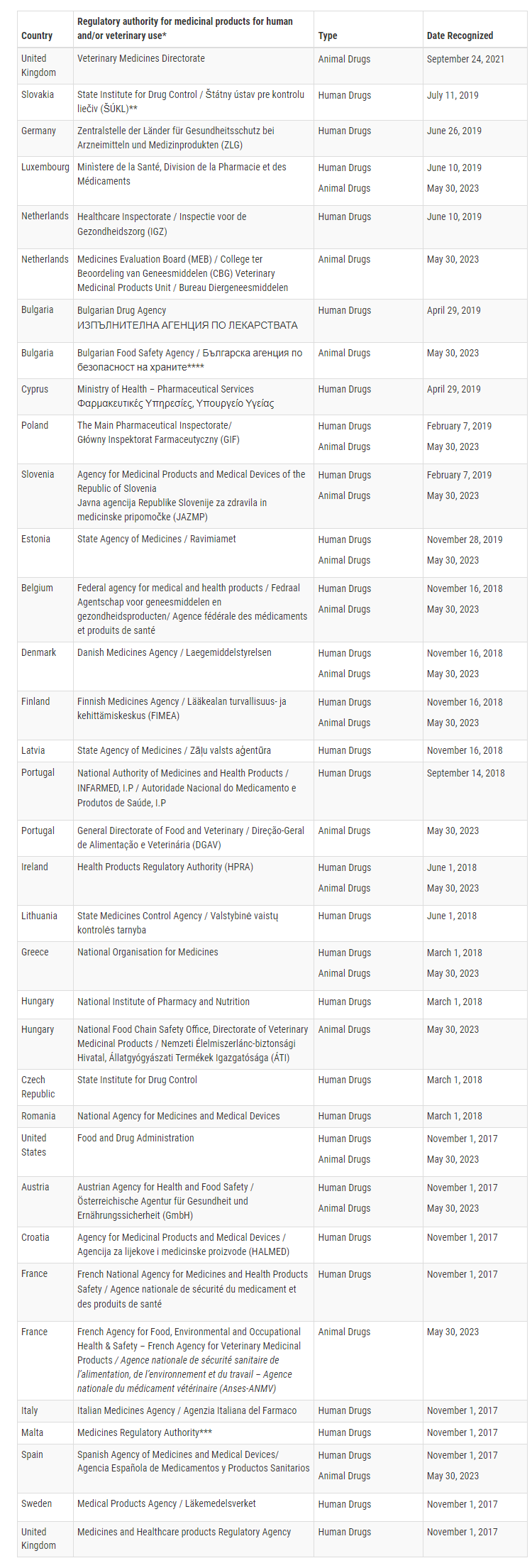
At the time of the announcement, the original article reported that the FDA had recognized the inspection capability of 16 EU member states for the covered veterinary products: Austria, Belgium, Bulgaria, Denmark, Estonia, Finland, France, Greece, Hungary, Ireland, Luxembourg, the Netherlands, Poland, Portugal, Slovenia and Spain.
Within the agreement’s applicable scope, the FDA could rely on qualifying GMP inspection information from those authorities, while EU authorities could rely on FDA inspections. The aim was to support regulatory cooperation and reduce unnecessary duplication. The list above describes the situation reported in 2023; check current regulator information before using it as a present-day list.

What Is a Mutual Recognition Agreement?
In this context, an MRA allows participating regulators to make use of qualifying drug-manufacturing inspection information from one another. The original article cited U.S. legislation from 2012 as part of the legal background for FDA recognition of inspections conducted by eligible foreign authorities.
- Less duplication: qualifying inspection information can reduce the need for repeated routine inspections of the same facilities.
- Better use of resources: regulators can direct inspection capacity toward facilities that warrant closer attention.
The agreement does not remove every inspection requirement, and its scope depends on the product, inspection type and participating authority.

Other Agreements Discussed at the Time
The original 2023 article also discussed FDA inspection cooperation with the EU and the United Kingdom, as well as an agreement signed with Switzerland in January 2023. It noted that capability assessments were relevant to when and how an agreement could be used. Signing an agreement should not be confused with confirming that every inspection type or product category is covered.
Limits and Proposed Next Steps
The article described the capability assessments as focused on routine surveillance inspections. It identified potential future discussion of human vaccines, plasma-derived pharmaceuticals and investigational products, subject to further assessment and the terms of each agreement. It also listed advanced therapy medicinal products, human blood and plasma, tissues and organs, cells in the Swissmedic context, and veterinary immunologicals as outside the scope it was discussing.
It reported that decisions concerning possible expansion to human vaccines and plasma-derived pharmaceuticals would be revisited in July 2025. That date has passed; this article does not confirm what was subsequently decided. Consult the current FDA and relevant partner-authority notices before relying on coverage or exclusions.

For enquiries about customized homecare products, contact insights@medasiagroup.com. Product-specific regulatory claims and documentation should be checked separately; this pharmaceutical GMP agreement does not establish medical-device certification.
WE RECOMMEND



Related posts


- Subscribe MedInsights
- Subscribe MedInsights
- Subscribe MedInsights
- Subscribe MedInsights
- Subscribe MedInsights