
Digital Pregnancy Test with Weeks (2026): Why It's a Game-Changer


Quick Answer: A digital pregnancy test with weeks does two things at once: it confirms whether you are pregnant and estimates how many weeks along you are — all on a clear LCD display. No line-reading, no guesswork. hCG detection accuracy is 99%+, and gestational week estimation is based on measured hCG concentration levels.
Digital Pregnancy Test with Weeks (2026): Why It's a Game-Changer
Discovering you're pregnant is a life-changing moment — and how you receive that information matters. A digital pregnancy test with weeks goes beyond a simple positive or negative. It tells you how far along you are, right from the first test. This guide explains the technology, the clinical advantages, and what to look for when choosing the right product.
The Problem with Traditional Pregnancy Tests

Traditional line-based pregnancy tests have three key limitations:
- Ambiguous results: Faint lines are notoriously hard to interpret. Many women retest multiple times due to uncertainty.
- Binary output only: Traditional tests tell you if you're pregnant — not how far along you are.
- Human error risk: Reading results too early (evaporation lines) or too late can produce misleading results.
Digital tests with weeks estimation solve all three problems simultaneously.
What Is a Digital Pregnancy Test with Weeks?
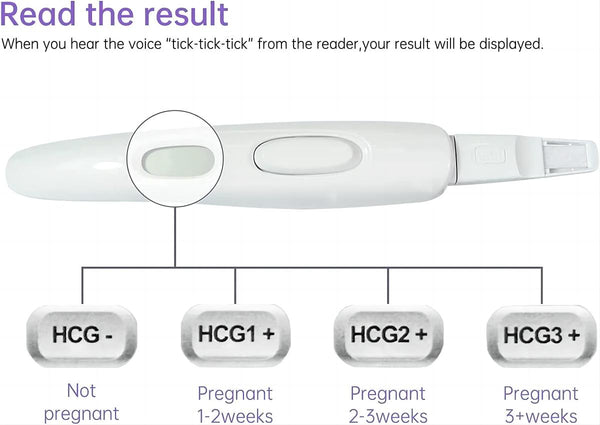
A digital pregnancy test with weeks is a home diagnostic device that detects hCG (human chorionic gonadotropin) in urine — the hormone produced by the placenta after implantation — and displays two outputs on an LCD screen:
- Pregnancy status: Pregnant or Not Pregnant
- Gestational estimate: How many weeks pregnant (e.g., 1–2 weeks, 2–3 weeks, 3+ weeks)
This dual output is made possible by measuring the concentration of hCG — not just its presence. Since hCG rises predictably in early pregnancy, the concentration correlates to an estimated gestational window.
How Does a Digital Pregnancy Test with Weeks Work?

- Urine is applied to the absorbent tip of the test strip.
- hCG is detected by antibodies on the test strip as urine travels through the device.
- hCG concentration is measured by a sensor and converted into a gestational week estimate.
- Results appear on the LCD within 3–5 minutes — clear text, no interpretation required.
- HCG 1+ — Pregnant, 1 to 2 weeks
- HCG 2+ — Pregnant, 2 to 3 weeks
- HCG 3+ — Pregnant, 3+ weeks
- HCG − — Not Pregnant
Key Benefits: Digital Pregnancy Test with Weeks vs Traditional Tests
- hCG detection accuracy — Traditional: 99%+ / Digital with Weeks: 99%+
- Result display — Traditional: Lines (ambiguous) / Digital with Weeks: Clear LCD text
- Gestational estimate — Traditional: No / Digital with Weeks: Yes (weeks indicator)
- Risk of misreading — Traditional: High / Digital with Weeks: Minimal
- User-friendliness — Traditional: Requires interpretation / Digital with Weeks: Instant, clear result
- Reusable option — Traditional: No / Digital with Weeks: Yes (Medasia model)
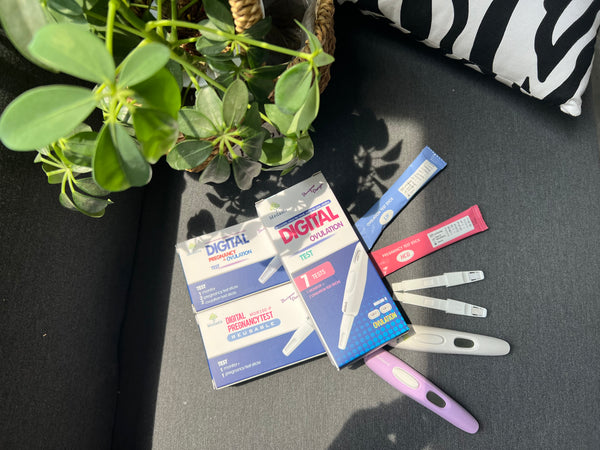
Additional Features to Look For
Beyond weeks estimation, leading digital pregnancy test models offer:
- Countdown / progress timer: Shows test processing in real time.
- Memory function: Stores previous results for comparison across cycles.
- Dual hCG + LH detection: Advanced models detect both pregnancy (hCG) and ovulation (LH) in a single reusable device.
- App connectivity: Some models sync with smartphone apps for cycle tracking and personalized guidance.
Interested in the Medasia Digital Pregnancy Test with Weeks?
CE-certified, 99%+ hCG accuracy, clear weeks-estimation LCD display. Reusable model available. OEM and private-label options for distributors worldwide.
Inquire About This Product →How to Get the Most Accurate Result
- Test on or after your missed period: hCG needs time to rise to detectable levels. Testing too early risks a false negative.
- Use first morning urine (FMU): hCG concentration is highest in FMU, improving both detection and weeks estimation accuracy.
- Follow the instructions exactly: Each model has specific timing requirements. Check the manufacturer guide before use.
- Choose a certified product: Look for CE, ISO 13485, FDA, or CFDA certification to ensure validated accuracy.

Frequently Asked Questions: Digital Pregnancy Test with Weeks
What is a digital pregnancy test with weeks?
It's a home pregnancy test that detects hCG in urine and displays two results on an LCD: whether you are pregnant, and an estimated gestational week range (1–2 weeks, 2–3 weeks, or 3+ weeks). It eliminates line-reading and provides immediate gestational context.
How does a digital pregnancy test estimate weeks?
The test measures the concentration of hCG in urine. Since hCG rises predictably in early pregnancy (roughly doubling every 48–72 hours), the measured concentration maps to an estimated gestational week range. Higher concentration = more weeks pregnant.
Is a digital pregnancy test with weeks more accurate than a line test?
Both detect hCG with 99%+ accuracy. The weeks-indicator digital test adds gestational estimation and eliminates result ambiguity — it does not change the underlying detection chemistry, but significantly improves the information value and user experience.
When should I use a digital pregnancy test with weeks?
Use it on or after the first day of your missed period with first morning urine for the most reliable result. Testing earlier may yield a negative even if pregnant, as hCG may not yet be at detectable concentrations.
Can I get these tests wholesale or with OEM branding?
Yes. Medasia Healthcare supplies digital pregnancy tests with weeks estimation to global distributors, pharmacies, and OEM buyers. MOQ starts at 1,000 units, with CE, ISO 13485, and CFDA certification. Custom packaging and logo available on request.
B2B Buyers & Distributors
Looking for OEM, private-label, or wholesale pricing on digital pregnancy tests with weeks? Our team responds within 24 hours.
Submit a B2B Inquiry →Explore More from Medasia MedInsight
WE RECOMMEND



Related posts


- Subscribe MedInsights
- Subscribe MedInsights
- Subscribe MedInsights
- Subscribe MedInsights
- Subscribe MedInsights